What is AI in Advertising?
AI in ads refers to the use of artificial intelligence technologies — such as machine learning and data analytics — to automate, optimise, and personalise ad campaigns. It helps brands show the right ad, to the right person, at the right time — faster and smarter than any human team could do manually. Advertising has always been about one thing: getting your message in front of the right person at the right moment. For decades, that meant guesswork — broad targeting, generic creatives, and hoping the numbers worked out. Today, that era is over.
At Marketing Scalers, we run performance campaigns for businesses across the USA and globally. And one shift we’ve seen more clearly than anything else over the past two years is this: brands that are winning with paid advertising aren’t just spending more — they’re using AI in ads to spend smarter.
This guide covers all of it — what AI in advertising actually means, how it works, real-world examples, and the honest challenges that come with it.
What Does AI Actually Do in Advertising?
Before we get into benefits and challenges, let’s make sure we’re on the same page about what artificial intelligence in advertising looks like in practice.
AI in advertising works by processing enormous amounts of data — browsing history, purchase patterns, demographic signals, time of day, device type, and more — and using that data to make smarter decisions automatically.
Here’s a simple breakdown of what AI handles inside modern ad platforms:
| AI Function | What It Does | Where You See It |
|---|---|---|
| Audience Targeting | Finds users most likely to convert based on behaviour | Meta Ads, Google Ads |
| Bid Optimisation | Adjusts your bid in real-time for every ad auction | Google Smart Bidding |
| Ad Creative Generation | Writes headlines, descriptions, and tests variations | Google Performance Max |
| Personalisation | Shows different ad versions to different users | Dynamic Ads on Meta |
| Fraud Detection | Flags fake clicks from bots before you pay for them | All major ad platforms |
| Predictive Analytics | Forecasts which campaigns will perform best | Facebook Ads Manager |
What are some real examples of AI being used in advertising?
One of the best ways to understand artificial intelligence ads is to see how real brands are using them.
- Google Performance Max — Google’s fully AI-driven campaign type analyses your creative assets, landing page, and audience signals to automatically place ads across Search, YouTube, Display, Gmail, and Maps. It decides the best placement, bid, and format for every single impression.
- Meta Advantage+ Campaigns — Meta’s AI takes your budget and creative and automatically identifies the best audiences, placements, and delivery times without requiring you to manually set up ad sets.
- Programmatic Advertising — Companies have used AI-powered programmatic advertising to achieve significant increases in click-through rates through real-time ad placement and optimisation.
- Personalised Ad Creative — Brands are now using AI to generate ad copy and visuals based on data and user behaviour, creating more effective and engaging ads at scale — without hiring a massive creative team.
These are not future predictions — they are happening right now in campaigns that Marketing Scalers manages for clients every single month.
What are the main benefits of using artificial intelligence in advertising?
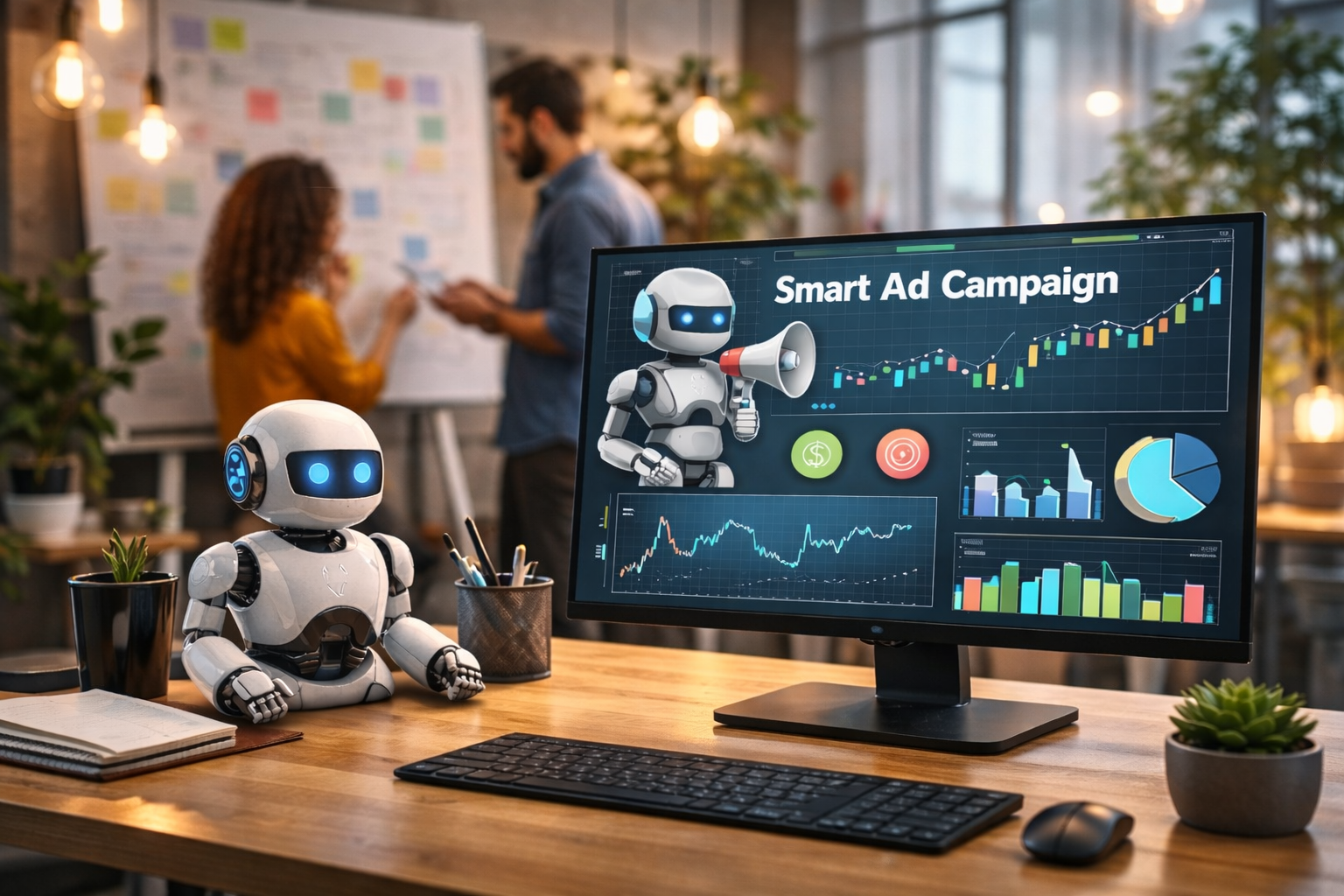
Here is where things get exciting. When used correctly, advertising and AI together can transform campaign performance in ways that traditional methods simply cannot match.
1. Smarter Audience Targeting
The biggest waste in advertising has always been showing ads to people who will never buy. AI fixes this problem at scale.
AI analyses thousands of data points per second — including purchase patterns, social media activity, and browsing history — to predict behaviours and preferences. For a business running Google or Meta ads, this means your budget is automatically concentrated on people who are most likely to convert, not just people who loosely match a demographic.
2. Real-Time Budget and Bid Management
Every second, thousands of ad auctions happen across platforms. No human team can monitor and react to all of them. AI can. It adjusts your bids in real time for every single auction — ensuring your money goes where it performs best, automatically.
3. Better Personalisation at Scale
Showing the same ad to every person is like sending the same email to your entire list with zero personalisation. AI analyses consumer data and behaviour to identify which ad works best with a particular audience segment — and serves them a version built specifically for where they are in the buying journey.
4. Faster Creative Testing
Traditional A/B testing takes weeks. You run two versions, wait for data, pick a winner, and repeat. AI compresses this entire cycle. Modern platforms can test dozens of creative combinations simultaneously and automatically shift spend toward what is working — in real time, not next month.
5. Ad Fraud Protection
Ad fraud costs the global advertising industry billions every year. AI can detect and flag fake clicks from bots or non-human traffic before you pay for them — protecting your budget and ensuring your campaign data is clean and trustworthy.
6. Improved ROI Overall
The bottom line of all the above is a better return on investment. Businesses using AI-powered advertising strategies report improved campaign performance and more efficient budget utilisation, with some seeing 15–20% improvements in overall marketing ROI.
What are the challenges or risks of AI in advertising?
It would not be an honest guide if we only talked about the upsides. AI in advertising comes with genuine challenges that every brand and agency needs to take seriously.
1. Data Privacy and Compliance
The more data AI uses, the more responsibility comes with it. With regulations like GDPR in Europe and evolving privacy laws across the USA, brands need to be careful about how they collect, store, and use consumer data to power their AI campaigns. Marketers must clearly communicate how customer data is used — and ensure AI systems operate within legal boundaries.
2. Algorithmic Bias
AI learns from data. If that data has bias built into it, the AI will carry and amplify it. Companies must audit their systems and use representative data sets when training algorithmic models — otherwise the AI may exclude or under-serve certain groups without anyone noticing.
3. Over-Reliance on Automation
AI is a tool, not a strategy. Many businesses make the mistake of handing everything over to automation and stepping back entirely. The results are usually disappointing.
The best outcomes in marketing and creative always come from human strategy paired with AI execution — not one replacing the other. The brands winning with AI are the ones where smart people guide what the AI is optimising for, not the ones who set it and forget it.
4. Lack of Contextual Understanding
AI is excellent at pattern recognition but still struggles with nuance. It can optimise for clicks and conversions, but it does not understand cultural sensitivity, brand tone, or the deeper emotional story behind your product.
This is why human creative direction will always be essential. AI can scale and test your creative — but humans need to define what the brand stands for and how it should communicate.
5. Transparency With Consumers
Consumers want to know how their data is being used and how advertising decisions are being made about them. Brands that are upfront about this build stronger trust — and stronger long-term relationships — than those that operate in the dark.
AI-Driven Advertising vs. Traditional Advertising
| Factor | Traditional Advertising | AI-Driven Advertising |
|---|---|---|
| Targeting | Broad demographic segments | Behaviour-based, individual-level precision |
| Decision Speed | Days or weeks to optimise | Real-time adjustments in milliseconds |
| Creative Testing | One or two versions at a time | Dozens of combinations tested simultaneously |
| Budget Management | Manual bid adjustments | Automated, always-on optimisation |
| Personalisation | Same ad for entire audience | Different versions for different user profiles |
| Fraud Protection | Limited or manual | Automated detection and blocking |
How Marketing Scalers Uses AI to Drive Advertising Results
At Marketing Scalers, AI is not something we talk about in pitch decks. It is embedded in how we build and manage every campaign we run. Here is how we put artificial intelligence ads to work for our clients:
- AI-Powered Audience Segmentation — We use machine learning to identify high-value audience segments that manual targeting would miss, including lookalike audiences built from your best existing customers.
- Creative Testing at Scale — We build multiple creative variations across headlines, visuals, and formats, then let AI identify the winning combinations faster than any manual process.
- Smart Bidding Strategies — We implement and tune AI-driven bidding on Google and Meta that continuously optimises for outcomes that matter — leads, sales, and ROAS — not just platform metrics.
- Full-Funnel Revenue Tracking — We connect ad performance data back to real revenue so the AI is always optimising for business results, not vanity numbers.
Conclusion
Artificial intelligence in advertising is not magic. It is not a replacement for strategy, creativity, or a genuine understanding of your customer.
What it is — when used correctly — is the most powerful performance accelerator available to modern advertisers. It takes your strategy and runs faster, tests smarter, and optimises harder than any team could manually. The businesses winning with AI are not the ones handing everything over to automation. They are the ones combining smart human thinking with AI-powered execution — and measuring everything along the way.
That is exactly the model Marketing Scalers is built on.