If your Meta ad performance has been inconsistent over the past several months, there is a concrete reason behind it. Meta rolled out one of the most significant infrastructure changes in its advertising history — an AI-powered system called Meta Andromeda. Most advertisers are running campaigns without knowing this system exists, let alone how it works.
Understanding Meta Andromeda is no longer optional for businesses serious about paid performance. This update fundamentally changed how ads are selected, ranked, and delivered across Facebook and Instagram. The strategies that worked in 2023 and 2024 are producing weaker results today — not because the platform is broken, but because the rules have changed.
This guide covers what Meta Andromeda is, how the andromeda update changed ad delivery, and what advertisers need to do right now to protect and grow their return on ad spend.
What Is Meta Andromeda?
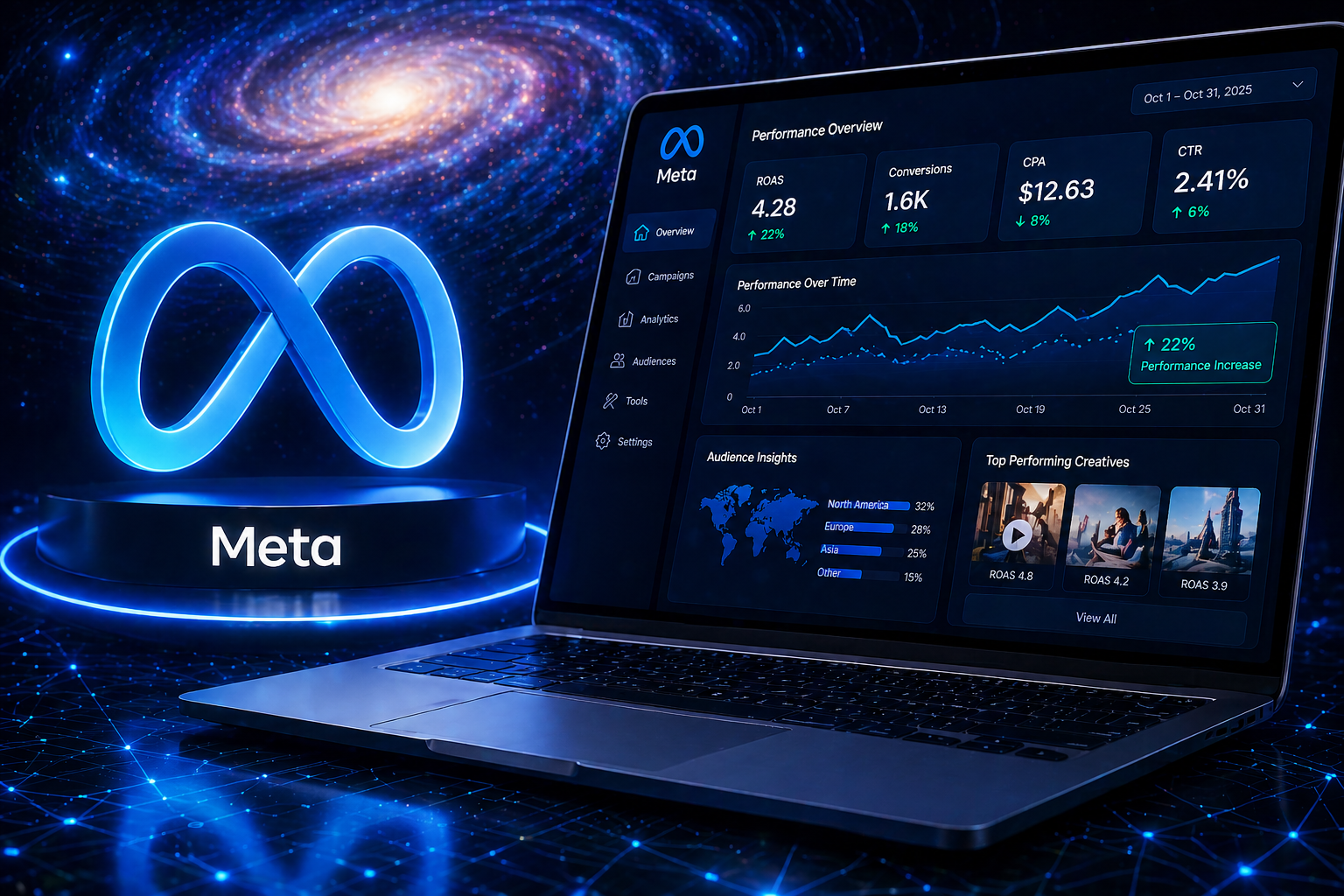
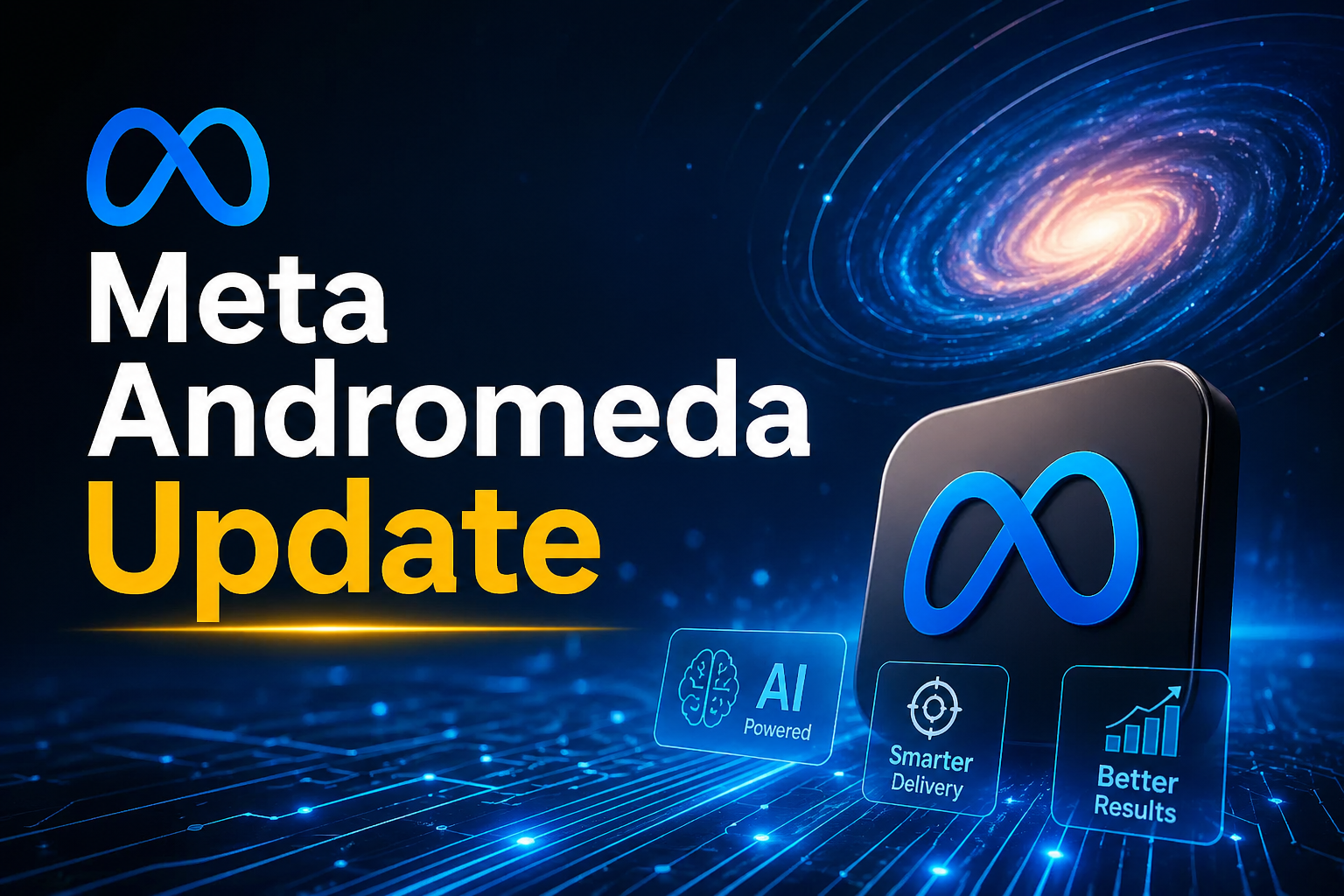
Meta Andromeda is Meta’s proprietary, AI-driven ads retrieval engine. It was introduced in 2024 and completed its global rollout across Facebook, Instagram, Messenger, and Meta’s broader ad network in October 2025.
At its core, Andromeda is responsible for the first critical step in ad delivery — retrieval. Every time a user loads their feed, Reels, or Stories, Meta’s system processes tens of millions of available ads and determines which candidates are eligible to be shown to that specific user at that specific moment. This decision happens in milliseconds.
Before Andromeda, this retrieval process relied on a combination of rule-based logic and earlier machine learning models that had limited personalization capability. The system worked within predefined audience parameters set by the advertiser. Andromeda replaces that entirely with deep neural networks capable of analyzing user behavior at a granularity and speed that the previous system could not approach.
The technical infrastructure comprises NVIDIA Grace Hopper Superchip hardware along with Meta’s proprietary silicon — the Meta Training and Inference Accelerator (MTIA). Collectively, these components facilitate a model complexity that is said to be 10,000 times more advanced than Meta’s earlier ads retrieval architecture.
What Changed With the Andromeda Update
The andromeda update did not just improve the existing system. It replaced the underlying logic that has governed Meta advertising for years. The implications are significant.
| Factor | Before Andromeda | After Andromeda Update |
|---|---|---|
| Primary delivery signal | Audience targeting parameters | Creative quality and user behavior signals |
| Personalization depth | Broad audience segments | Individual-level, real-time matching |
| Ads processed per auction | Limited candidate pool | Tens of millions of candidates |
| Recommended ads per campaign | 2–6 ads per ad set | 10–20+ distinct creative concepts |
| Narrow interest targeting | Effective and widely used | Now limits AI optimization capability |
| Campaign structure | Segmented and manually controlled | Consolidated and AI-driven |
| Manual override value | High | Significantly reduced |
The most consequential shift is the move from audience-first to creative-first delivery. Under the previous system, advertisers defined who would see their ads through interest stacks, demographic filters, and lookalike audiences. Andromeda inverted that model. The system now evaluates ad creative against thousands of behavioral signals per user and determines relevance on its own — with the advertiser’s creative being the primary input.
How Meta Andromeda Works?
Andromeda operates at the retrieval stage — before the ad auction even begins. Here is how the full delivery process functions under the andromeda meta ads system:
Stage 1 — Retrieval (Andromeda)
Andromeda scans the entire pool of eligible ads — which can number in the tens of millions — and narrows the field down to several thousand candidates relevant to a specific user. It evaluates historical engagement patterns, current session behavior, past ad interactions, content consumption history, and conversion data.
Stage 2 — Ranking (Meta GEM)
Meta’s Generative Ads Recommendation Model (GEM) takes the candidates surfaced by Andromeda and ranks them by predicted relevance and conversion probability. GEM identifies patterns across organic interactions, ad sequences, and behavioral data, then feeds those predictions back into Andromeda for continuous refinement.
Stage 3 — Auction
Top-ranked candidates enter the standard ad auction where budget, bid strategy, and estimated action rates determine the final winner.
Stage 4 — Delivery
The selected ad is served to the user. The entire process — from retrieval through delivery — happens within the latency window of a single feed load.
What makes this system meaningfully different is the depth at which Andromeda evaluates creative. The system now analyzes video hooks independently (the first three seconds are scored separately from overall creative performance), processes on-screen text for messaging alignment, and even evaluates audio signals in video ads. Creative is no longer just a component of the campaign — it is the primary performance lever.
Verified Performance Data From the Andromeda Meta Update
The following figures come from Meta’s engineering documentation and independently validated advertiser data:
| Metric | Verified Result |
|---|---|
| ROAS increase with Advantage+ creative enabled | +22% |
| Ads quality improvement across the platform | +8% |
| Retrieval recall improvement | +6% |
| Conversion increase using Meta’s GenAI image tools | +7% |
| Advertisers using GenAI ad tools in a single month | 1,000,000+ |
| Ads generated via GenAI tools in a single month | 15,000,000+ |
| GEM efficiency vs. original ranking models | 4x more efficient |
These are not projections. These numbers reflect what is already happening on the platform. Advertisers who have restructured their strategy around Andromeda’s requirements are seeing measurable gains. Those maintaining legacy approaches are seeing quiet but consistent performance decline.
What the Andromeda Update Means for Your Ad Strategy

1. Creative Diversity Is Now a Structural Requirement
Running two or three variations of the same ad concept is no longer sufficient. Andromeda groups similar creatives together and treats them as a single option. To perform, the system needs a meaningful range of inputs.
| Qualifies as Real Creative Diversity | Does Not Qualify |
|---|---|
| Different narrative angles (value vs. urgency vs. social proof) | Changing a CTA button color |
| Distinct formats (video, static, carousel, Reels) | Swapping one headline word |
| New visual concepts and settings | Minor crop or layout adjustments |
| Different talent, spokesperson, or testimonial style | Adding or removing an emoji |
| Varied hooks and opening sequences | Reordering existing creative elements |
The target range recommended by performance specialists is 10 to 20 genuinely distinct creative concepts per campaign — each providing a different signal for Andromeda to test against different user profiles.
2. Broad Targeting Now Outperforms Narrow Segmentation
This is the adjustment that challenges the most experienced media buyers. Detailed interest targeting — layered audience parameters built around specific demographics, behaviors, and affinities — now actively restricts Andromeda’s ability to find high-value users.
The AI processes behavioral signals at a depth that manual interest stacks cannot replicate. Giving Andromeda a broad audience allows it to identify conversion-ready users across a wider spectrum. Accounts that have moved to broad targeting are consistently outperforming those still relying on hyper-segmented audiences.
3. Campaign Architecture Should Be Simplified
Fragmented structures — multiple campaigns with numerous ad sets targeting slight audience variations — reduce the data volume flowing through each individual campaign. Andromeda learns and optimizes based on signal volume. Splitting that signal across many structures slows learning and degrades performance.
Recommended structural approach:
- Fewer campaigns with consolidated budgets
- Broad audience targeting at the ad set level
- Advantage+ placements enabled to allow the system to allocate inventory optimally
- Intermediate conversion events tracked (engagement, add-to-cart, lead form opens) to give the system more learning data in lower-volume campaigns
4. Avoid Frequent Campaign Edits During the Learning Phase
Andromeda requires a stabilization period after campaign launch or structural changes. Frequent edits — adjusting budgets, swapping creatives, changing targeting — reset the learning phase and interrupt pattern recognition. Early performance volatility is expected and does not indicate campaign failure.
Conclusion
Meta Andromeda represents a fundamental redesign of how paid advertising works on the world’s largest social platform. The shift from audience-first to creative-first delivery changes what advertisers should prioritize, how campaigns should be structured, and how performance should be evaluated.
The core principles are clear: produce more creative diversity, simplify campaign architecture, move toward broad targeting, and give the system adequate time and signal volume to optimize.
At Marketing Scalers, we work with businesses across the U.S. to build performance-driven Meta ad strategies that are aligned with how the platform actually operates — not how it operated two years ago. If your current campaigns are not delivering the returns your business requires, the andromeda update is very likely a contributing factor.
We build the creative frameworks, account structures, and optimization processes that position your ad spend to perform under Meta’s AI-first infrastructure — and to scale from there. Marketing Scalers is a performance-based digital advertising agency serving businesses across the United States. Our approach is built on data, accountability, and measurable growth.